X

Pesquisas Internas

  •  


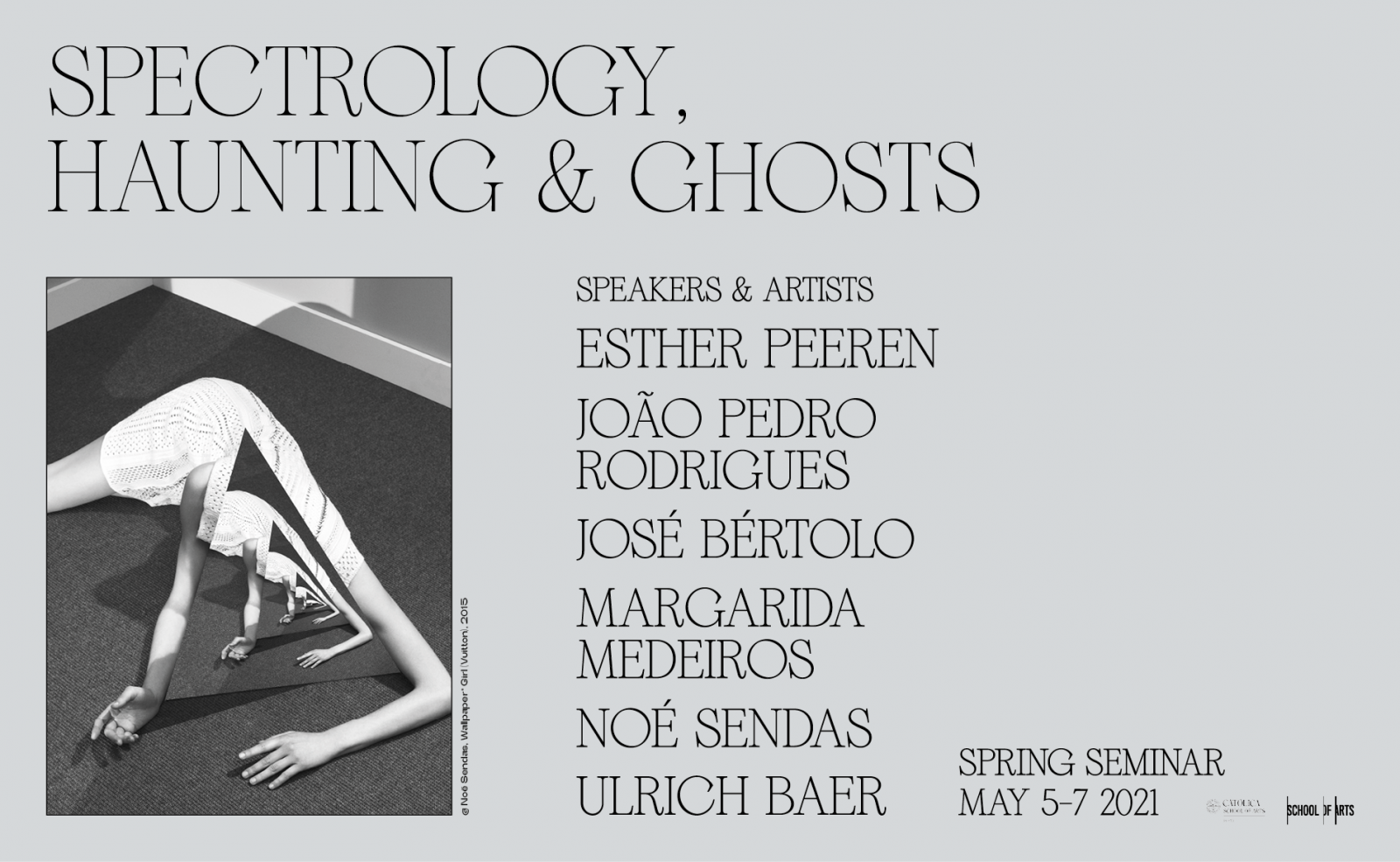
    Spring Seminar 2021 · Spectrology, Haunting and Ghosts
    5-7 MAY 2021
    School of Arts at Universidade Católica Portuguesa
    Porto, Portugal
    Programa completo e mais informações aqui.

    Organizing Committee
    Daniel Ribas
    Nuno Crespo
     
    Keynote Speakers and Artist Talks
    Esther Peeren
    João Pedro Rodrigues
    José Bértolo
    Loretta Fahrenholz
    Margarida Medeiros
    Noé Sendas
    Ulrich Baer
     
    Some artworks, from cinema to visual arts and photography, have absorbed phenomena like ghosts, zombies, illness, death, spectra, apparitions, and other kind of “in-between” states of being. This kind of liminality is a way of bringing forward in our historical present its profound ambiguity. 
     
    Images are ontologically problematic in their approach to reality. They are always a representation of a time and a space, and their manipulation puts into question their indexicality.
     
    This liminality of ghosts, spectra and apparitions is also a way of analyzing the complexity of our historical present, in both its linearity and a cross-over of past, present and future. Therefore, these “in-between” states discuss issues of the traumatic past, as are empowerments to change the future. That is, the traumatic past haunts the historical present demanding new ways of knowing the world and history that will transform power structures.
     
    This seminar aims to map and discuss contemporary manifestations in art & cinema of these phenomena.
     
    We welcome papers on the following topics:
    • Critical theory on spectrology, haunting and ghosts
    • Cinema and visual arts that incorporate or relate to ghosts, zombies or dead people
    • Spaces of liminality in cinema and contemporary art
    • Artworks that use spectrology, haunting and ghosts as means to speak trauma
    • Alternative uses of narrative dealing with these “in-between” states
    • How certain images haunt the historical present
    • Uncovering archives


    + info: springseminar.arts@porto.ucp.pt

    If you want to receive additional information on other programs and opportunities, please subscribe our newsletter here


    Disclaimer: Due to COVID-19 pandemic, this event could take a hybrid format.
    Decisions will be communicated by the event's Organizing Committee in due course, according to the evolution of the global pandemic situation.


  • Na próxima sessão do Ano Laudato si', intitulada Ecos e Olhares sobre a Laudato si', queremos dar voz a alunos (Licenciatura e Mestrado) que refletiram sobre este texto inspirador a partir da sua área de especialização, ou seja, a Ciência Política e as Relações Internacionais, as Línguas e a Cultura e a Teologia.

    A sessão apresentará as seguintes perspetivas:

    • Andreia Leitão (3º ano CP&RI - IEP), Cuidar da Casa Comum no prisma das "Novas Guerras";
    • Maria Ana Baranda (1º ano LEA – FCH), A Laudato si' no prisma dos Objetivos do Desenvolvimento Sustentável;
    • Miguel Serra (Mestre da FT), Cuidar da Casa Comum no prisma da Educação Moral e Religiosa.

    A moderação desta mesa-redonda virtual será assegurada pela Professora Mónica Dias, do Instituto de Estudos Políticos (IEP).

    Após os olhares dos estudantes, segue-se um tempo para debate, contando com dois membros da Rede “Cuidar da Casa Comum” Juan Ambrosio, da Faculdade de Teologia (FT), e Inês Espada Vieira, da Faculdade de Ciências Humanas (FCH), que é também vice-presidente do CRC, Centro de Reflexão Cristã, para encerrarem a sessão com os ecos deste encontro.

    A sessão decorre no dia 24 de março, entre as 12:00 e as 13:00, através da plataforma zoom.

    Esta sessão é organizada em parceria com o Centro de Reflexão Cristã e a Rede Cuidar da Casa Comum.


    Iniciativas do Ano Laudato Si »»

  • Entre em https://eu.bbcollab.com/guest/712125526af84655b99cee40054b142f no dia 26 de março de 2021 às 14h15 e assista à palestra de Ivone Vaz Moreira. A "entrada" é livre e gratuita, sem necessidade de pré-inscrição. O evento decorre em inglês.

    Resumo
    Water is a major habitat for microorganisms and an important vehicle for the dissemination of antibiotic resistance. The understanding of how that dissemination can occur relies on a deeper understanding of the bacterial diversity in water, including drinking water. The study of the bacterial diversity relies on a multi-level approach, since the organism, groups of organisms, or the whole bacterial community may provide different and complementary perspectives.


  • Speaker: Ivone Vaz Moreira

    Link: https://eu.bbcollab.com/guest/712125526af84655b99cee40054b142f

    Description
    Water is a major habitat for microorganisms and an important vehicle for the dissemination of antibiotic resistance. The understanding of how that dissemination can occur relies on a deeper understanding of the bacterial diversity in water, including drinking water. The study of the bacterial diversity relies on a multi-level approach, since the organism, groups of organisms, or the whole bacterial community may provide different and complementary perspectives.
     

  • À COMUNIDADE ACADÉMICA
     
    É com muita alegria que convido todos os membros da comunidade académica (alunos, docentes e funcionários) a participar na Missa da Páscoa, que será presidida por Sua Eminência Reverendíssima Senhor D. Manuel Clemente, Cardeal Patriarca de Lisboa e nosso Magno Chanceler no próximo dia, 25 de março, às 12h00. Esta missa será transmitida no Facebook Institucional.

    A Reitora,
    Isabel Capeloa Gil


    TO THE ACADEMIC COMMUNITY

    It is with great joy that I invite all members of the academic community (students, faculty and staff) to participate in UCP’s Easter Mass, on 25 March, at 12h00. The Mass will be broadcast on Institutional Facebook.

    The Rector,
    Isabel Capeloa Gil
     

  • Before the COVID-19 pandemics, the World Health Organization considered Antimicrobial Resistance a leading global public health issue. While in health-care units antimicrobial resistance endangers lives, well-being and the success of medical interventions, the environmental contamination with resistant microorganisms, in particular antibiotic resistant bacteria and antibiotic resistance genes, globally disseminated. In urban areas, wastewater treatment plants are the major barriers to protect the environment and the human health from these emerging contaminants, although are not prepared to reduce resistance to safe levels. Food-animals are also reported as important hosts of antibiotic resistant bacteria. This diffuse occurrence of antibiotic resistant bacteria leads to a wide spectrum of contamination that crosses humans, animals and the environment, being uncertain which are the most critical reservoirs and paths of dissemination.

    The One-Health concept relying on the continuum humans, animals and the environment, assumes the interdependence of human-health on the broad context of human-environment interfaces.

    This seminar brings together antibiotic resistance experts, working in distinct fields of the One-Health continuum, who will discuss the implications of the multiple intersections between environment, animals and humans and the consequences in terms of antibiotic resistance dissemination.

    Programme here

  • Se a Comunicação é um desafio em qualquer setor de atividade, a Comunicação na área da saúde, num contexto de pandemia, é vital.
    Como gerir a Comunicação num contexto em que todos os públicos criam conteúdos? Qual o impacto do digital e deste consumidor hiperconectado na Comunicação na área da saúde? Serão os Hospitais públicas marcas? Serão os profissionais de saúde marcas? Quais as especificidades destas marcas e como fazer a sua gestão? Qual o papel da Comunicação interna num contexto de crise? Que aprendizagens foram feitas num ano de COVID 19?

    Estas e outras questões serão o foco da conversa entre Ana Côrte-Real, Diretora do MBA Executivo da Católica Porto Business School e Jorge Jorge, Marketing, Brand & Communication Director no Centro Hospitalar Universitário São João e Alumnus da Católica Porto Business School.

    Este webinar será dinamizado por:

    Jorge Jorge
    Diretor de Comunicação, Marketing e Marca do Centro Hospitalar Universitário de São João no Porto sendo responsável pelo desenvolvimento e implementação de uma Estratégia Global de Comunicação e Marketing na instituição.
    Licenciado em Comunicação pela Universidade do Porto, possui um Executive Master (Pós-Graduação) em Marketing pela Católica Porto Business School e mais recentemente um MBA Internacional pela Católica Porto Business School / ESADE Barcelona / PUC São Paulo. É Doutorando em Medias Digitais pela UP e Universidade de Texas em Austin tendo formações em Inovação e Liderança pelo INSEAD em Fontainebleau e mais recentemente em Digital Transformation pela London Business School.


    Ana Côrte-Real
    Diretora do MBA Executivo

    Os Moving to the Future Webinars são gravados e posteriormente disponibilizados na nossa página de Youtube. Encontre-os aqui!

  • No âmbito da Pós-Graduação em Nutrição Pediátrica, realiza-se no dia 26 de março, entre as 14h e as 16h, uma Masterclass intitulada “Avaliação do estado de nutrição na criança nascida pré-termo: antropometria, parâmetros bioquímicos, composição corporal e calorimetria indireta”, com a presença de Luís Pereira da Silva.

    A participação é gratuita.

  •  

    SEE ENGLISH BELOW

    Aulas abertas 2021 · Arte / Pensamento / Som
    Warren Neidich · Ruído, Indeterminação e o Cérebro sem Órgãos
    22 ABR · 18H30 · On-Line Lecture

    Moderador · Cristina Sá
     
    O ruído é predominante na nossa sociedade pós-industrial. Seja apresentada como a cacofonia da fábrica e da máquina de guerra, o barulho causado pelo movimento anárquico de carros e camiões, o clamor da música grunge emanando de colunas num centro comercial ou a estática do entupimento de redes de informação, o ruído tem má reputação. É habitualmente considerado ofensivo e algo que tem de ser controlado ou mitigado. Contudo, o ruído tem um outro lado mais positivo e emancipatório na medida em que hoje representa formas e meios de constituir novas formas de conhecimento e de formas de compreender organização. Esta conceção contemporânea de ruído cria novas possibilidades para as formas e eventos que caracterizam e acusticamente transformam a banda-sonora que constitui as nossas paisagens culturais – sejam elas reais, imaginárias ou virtuais. Onde no passado o ruído era algo a ser suprimido, hoje é um conceito chave para as noções de emergência, complexidade e não-linearidade. Hoje, o ruído e a incerteza são consideradas a par da contingência como forças motrizes de inovação, criatividade e resistência.
     
    Depois de escrever esta nova estrutura conceptual a que chama Neuroestética Ativista, Warren Neidich pretende compreender uma nova possibilidade para o ruído enquanto desarticulador entre as condições materiais de associações culturais disruptivas e redes de atenção que abraçam o ruído, aquilo a que Neidich chama de cérebro extra-craniano, e a arquitetura material do cérebro intra-craniano hospedado no crânio ósseo. Fundamental aqui é o emaranhamento e o espelhamento do cérebro intra-craniano com a plasticidade cultural. Neidich pretende explorar as consequências políticas emancipatórias da cacofonia de indeterminação e a improvisação e a sua lógica cultural para compreender as ligações que existem entre si e a variação e plasticidade do cérebro.
     

    A sessão será transmitida no dia 22 de abril às 18h30 nesta página.
     
    The session will be broadcasted live in this page on April 22nd at 6:30 pm.
     

    BIO

    Tendo estudado fotografia, neurociência, medicina e arquitetura, Warren Neidich traz para qualquer plataforma de discussão uma posição interdisciplinar única a que ele chama "trans-pensamento." Atualmente utiliza vídeo e néon para criar polinização cruzada de trabalhos de texto conceptuais que refletem sobre situações na zona de fronteira entre arte, ciência e justiça social. O seu trabalho performativo e escultural “Pizzagate Neon” (2018), uma grande escultura de néon suspenso foi exposta recentemente na Bienal de Veneza de 2019, analisando as relações de Fake News, a economia de atenção em rede, a evolução de hábitos tecno-culturais e a co-evolução da arquitetura do cérebro.
     
    O seu projeto conceptual "Drive-By-Art (Public Sculpture in This Moment of Social Distancing)" abriu recentemente na South Fork de Long Island e Los Angeles com críticas elogiosas em meios como The New York Times, Hyperallergic, The Art Newspaper, Time Out e Los Angeles Magazine. Ele é fundador e diretor do SaasFee Summer Institute of Art (2015-), uma pós-graduação de teoria intensiva que atrai estudantes de todo o mundo e que funciona em Los Angeles, New York City e Berlin.
     
    Em 1996, ele fundou o www.artbrain.org e o Journal of Neuroaesthetics que está ativo até hoje incluindo um recente número sobre "Arte e Telepatia". Já recebeu os prémios Vilem Flusser Theory Award, Transmediale, AHRB/ACE Arts e Science Research Fellowship, Bristol e a Fulbright Scholarship. Adicionalmente, ele foi tutor nos departamentos de artes visuais, ciência computacional e estudos culturais no Goldsmiths College (2004-2008) onde, em colaboração com o Center for Cultural Studies, criou a primeira conferência em Neuroaesthetics (2005), bem como o Departamento de Neuroaesthetics (2005-2008). Enquanto bolseiro de investigação à distância da TU Delft School of Architecture ele coeditou (com Deborah Hauptmann) Cognitive Architecture: From Biopolitics to Noo-Politics. Desde então, editou três volumes das Psychopathologies of Cognitive Capitalism, publicados pela Archive Books, e Neuromacht, publicada em alemão pela Merve Verlag. O seu Glossary of Cognitive Activism foi publicado na inauguração da sua exposição solo “Rumor to Delusion” na Bienal de Veneza de 2019. Recentemente, foi professor de artes na Weißensee Kunsthochschule em Berlin (2017-2018).
     
    No seu percurso tem sido orador visitante nos departamentos de arte em instituições como Brown University, GSD Harvard University, Columbia University, Princeton University, Southern California Institute of Architecture, UCLA, La Sorbonne Paris, University of Oxford e Cambridge University.


    Open programme 2021 · Art / Thought / Sound
    Warren Neidich · NOISE, INDETERMINACY AND THE BRAIN WITHOUT ORGANS

    22 ABR · 18H30 · On-Line Lecture

    Moderator · Cristina Sá

    Noise is prevalent in our post-industrial society. Whether presenting as the cacophony of the factory and war machine, the racket caused by the anarchic movement of cars and trucks, the clamor of grunge music emanating from loud speakers in a mall or the static clogging of information networks, noise gets a bad rap. It is usually considered offensive and something that needs to be controlled or mitigated. However, noise has another side more positive and emancipatory as it today represents a ways and means to constitute new forms of knowledge and of ways of understanding organization. This contemporary conception of noise creates new possibilities for the forms, shapes and events that characterize and acoustically shape the sound track constituting our cultural landscapes – be they real, imaginary or virtual. Where in the past noise was something to be suppressed, today it is a key concept in notions of emergence, complexity and non-linearity. Today, noise and uncertainty are embraced alongside contingency as a driving force of innovation, creativity and resistance.
     
    After describing the new framework I call Activist Neuroaesthetics I want to understand a new possibility for noise as an disarticulator between the material conditions of the disruptive cultural associations and attention networks that embracing noise generates, what I refer to as the extra- -cranial brain, and the material architecture of the intra-cranial brain housed in the bony skull. Key here is the intracranial brains entanglement with and mirroring of cultural plasticity. I want to explore the emancipatory political consequences of the cacophony of indeterminacy and improvisation and its cultural logic to understand the links between it and the brains neural variation and plasticity.

    BIO

    Having studied photography, neuroscience, medicine and architecture, Warren Neidich brings to any discussion platform a unique interdisciplinary position that he calls “trans-thinking.” He currently uses video and neon to create cross pollinating conceptual text-based works that reflect upon situations at the border zone of art, science and social justice. His performative and sculptural work “Pizzagate Neon” (2018), a large hanging neon sculpture recently on display at the 2019 Venice Biennial, analyzed the relations of Fake News, networked attention economy, evolving techno-cultural habitus, and the co-evolving architecture of the brain.
     
    His recent conceptual project Drive-By-Art (Public Sculpture in This Moment of Social Distancing) just opened on the South Fork of Long Island and Los Angeles to acclaim including reviews in The New York Times, Hyperallergic, The Art Newspaper, Time Out and Los Angeles Magazine. He is founder and director of the SaasFee Summer Institute of Art (2015-), a theory intensive postgraduate course that attracts students worldwide operating in Los Angeles, New York City and Berlin.
     
    In 1996, he founded www.artbrain.org and the Journal of Neuroaesthetics which is still active today including a recent issue on “Art and Telepathy.” He is a recipient of the Vilem Flusser Theory Award, Transmediale, AHRB/ACE Arts and Science Research Fellowship, Bristol and a Fulbright Scholarship. Additionally, he was a tutor in the departments of visual art, computer science and cultural studies at Goldsmiths College (2004-2008) where, in collaboration with the Center for Cultural Studies, he created the first conference on Neuroaesthetics (2005), as well as a Department of Neuroaesthetics (2005-2008). As a remote research fellow at TU Delft School of Architecture he coedited (with Deborah Hauptmann) Cognitive Architecture: From Biopolitics to Noo-Politics. Thereafter, he edited three volumes of the Psychopathologies of Cognitive Capitalism, published by Archive Books, and Neuromacht, published in German by Merve Verlag. His Glossary of Cognitive Activism was published for the opening of his solo exhibition “Rumor to Delusion” at the 2019 Venice Biennial. Recently, he served as Professor of Art at Weißensee Kunsthochschule in Berlin (2017-2018).
     
    He has been a visiting lecturer in art departments at Brown University, GSD Harvard University, Columbia University, Princeton University, Southern California Institute of Architecture, UCLA, La Sorbonne Paris, University of Oxford and Cambridge University.


    Interfacing Art, Science and Social Justice in Warren Neidich’s Artwork by Cristina Sá

     
    There is always an experience of excitement when navigating an overwhelmingly interesting aggregate of information. 
     
    There are too many important threads to follow and too many possibilities to weave them. 
    Dots-lines-planes (plateaus) revolve fluently, dynamically intersecting in a heterogeneous complex. 
    Intertwining resonations at a sensitive, emotional and cognitive level. 
     
    Such was the nature of my encounter with Warren Neidich’s work. 
    When facing such an imminent incapacity for synthesis, I often return to the concept of interface as a complex of mediation. It helps me to navigate and allows me to observe everchanging connections, because my standing point is the in-between space. From there, I can follow the path of the activated interstices between different elements. This is how I hope to see Warren Neidich’s work at work, doing what it does: combining.
     
    art, science and social justice
    theory and practice
    concepts and instances 
     
    and doing so by creating and curating artworks.
    In an interdisciplinary position and exercising the possible “trans-thinking”, I feel confident to grasp the originality on these impure territories for creation.
    Neidich works in the “border zone of art, social justice and science”. This means not only recognizing the tangencies of these fields but to move further, deeper, to the very fabric that dynamically links photography, neurosciences, medicine and architecture. 
     
    To work in between. 
    To work in the transposing place in which metaphors flourish,
    not on one side, not on the other, on both, on none. 
    Hybrid. 
     
    This is a happy vibrating place, where intermittent liaisons change by the moment. 
     
    Not permanent. 
    Plastic.
     
    And the artist lets this in-betweenness be patent in the artwork. I believe this is what Warren Neidich means by saying he is a wet artist. He reverses “the conceptualists’ movement that withdrew sensitivity from their artwork in the search for a pure cognitive experience”. An interdisciplinary practice cannot be dry, it’s nature it not one of restraining, or of sustaining cleavages, or even of withholding possibilities in the search for purity. On the contrary, it is inclusive, open, and embraces the crossbreed: the mutt, if I may say so. 
     
    The be open is to be changeable. 
    To be reconfigurable.
    To leave all options available.
    To be open is to be unlimited and to accept the stimulus that come from without (environment)
    To recognize the influence of your milieu.
    And to act upon it.
    And to act is the possibility to change, perchance to attain truth and reestablish justice.
     
    Wet, through moist media (in Ascott’s assertion).
    In the firm believe that it is through the interface that media are experienced and therefore instantiated in space-time-matter, this reference to moist media leads me to question the materiality of Neidich’s work. 
     
    Artworks’ matter
     
    It is absolutely necessary to consider matter in its trinity along with space and time, and to do that through light:
     
    “Once astrophysicists stop talking exclusively about ‘space-time’ and start talking about ‘space-time-matter’ […] introducing a third kind of interval of the ‘light’ type alongside of those of ‘space’ and ‘time’, they engineer the emergence of a new conception of time, which is no longer exclusively the time of classic chronological succession, but now a time of (chronoscopic) exposure of the duration of events at the speed of light” 
    Paul Virilio, Open sky. (London: Verso 2003) Reprint. ed. p.3 
     
    From Einstein on, understanding space-time implies considering the masses, the particles and their behavior, namely through its relation with light: something very appropriate in this digital dematerialization era. Even more appropriate is to consider Light Art in this digital dematerialization era.
    Immediately comes to mind the artists’ text-based neon sculptures. With their “light” material and in their networked textual arrangements, they open possibilities of interconnection.  
     
    the continuum
    from past to present, of art
    from material to immaterial, through light
    from network-based model of the brain to networked digital experience.
     
    And through this apparent continuity of space-time-matter (continuous only in our experience level, yet granular and dynamic on its fabric) these pieces mirror the subject of our time. A subject whose individuality and sociability are technically determined and equipped, not only in terms of sensitivity and sensibility, but also in terms of affections and emotions. 



  •  

    SEE ENGLISH BELOW

    Aulas abertas 2021 · Arte / Pensamento / Som
    Ricardo Jacinto · Medusa — Solo para Violoncelo, Eletrónica e Objetos Ressonantes
    ADIADO · 18H30 · Performance

    Moderador · José Alberto Gomes

    INFORMAÇÃO:
    Informamos que por motivos alheios à EA, a sessão desta semana do programa de Aulas Abertas, com Ricardo Jacinto, terá de ser adiada. 
    A nova data será anunciada brevemente.
    Obrigado pela compreensão.
     
    Esta sessão será em Português.
     

    Servindo-se de um sistema de amplificação sonora distribuído por diferentes pontos do violoncelo, Ricardo Jacinto explora possibilidade de fragmentação e dispersão sónica dos seus gestos no corpo do instrumento. No decorrer das improvisações, a “explosão” do violoncelo é articulada com a auscultação do espaço acústico e da paisagem sonora circundantes. — www.osso.pt/projectos/medusa.


    A sessão será transmitida no dia 29 de abril às 18h30 nesta página.
     
    The session will be broadcasted live in this page on April 29th at 6:30 pm.

    BIO

    Músico, artista plástico e arquitecto com pesquisa artística e académica focada na relação entre som e território em práticas transdisciplinares. É membro fundador e co-director artístico do colectivo OSSO e é doutorado pelo Sonic Arts Research Center, Queens University Belfast. Desde 1998 tem apresentado seu trabalho em exposições individuais e colectivas, concertos e performances em Portugal e Europa, e tem colaborado extensivamente com outros artistas, músicos, arquitetos e performers. A sua música foi editada pela Clean Feed, Shhpuma Records e Creative Sources. É representado pela Galeria Bruno Múrias e as suas instalações estão presentes em várias coleções nacionais: Fundação de Serralves, Caixa Geral de Depósitos, Fundação Leal Rios or Fundação António Cachola. Foi co-representante de Portugal na 10a Bienal de Veneza de Arquitectura 2006 e o seu trabalho foi apresentado em diferentes locais como a Culturgest (Lisboa e Porto), Fundação de Serralves, Fundação Calouste Gulbenkian, Palais de Tokyo, Mudam_Luxembourg, Teatro Maria Matos, Museo Vostell, Casa da Música, CCB, Manifesta 08_European Bienal of Contemporary Art, Frac Loraine_Metz ou OK CENTRE_ Linz, entre outras.

    website / bandcamp


    Open programme 2021 · Art / Thought / Sound
    Ricardo Jacinto · Medusa – Solo for Cello, Electronics and Resonant Objects
    29 APR · 18H30 · Performance
     
    Moderator · José Alberto Gomes
     
    Making use of a sound amplification system distributed by different poils of the cello, Ricardo Jacint explores the possibility of fragmentation and sonic dispersion of his gestures in the body of the instrument. Throught the improvisations, the "explosion" of the cello is articulated with the listening of the acoustic space and the surrounding soundscape.

    BIO

    Musician, visual artist and architect with artistic and academic research focused in the relation between sound and territory in transdisciplinary practices. Hes a founding member and artistic co-director of the collective OSSO and he holds a PhD by the Sonic Arts Research Center, Queens University Belfast. Since 1998 he has presented his work in individual and collective exhibitions, concerts and performances in Portugal and Europe, and he has collaborated extensively with other artists, musicians, architects and performers. His music was released by Clean Feed, Shhpuma Records e Creative Sources. He is represent by Galeria Bruno Múrias and his installations are present in several portuguese collections: Fundação de Serralves, Caixa Geral de Depósitos, Fundação Leal Rios or Fundação António Cachola. He was one of the representatives of Portugal in the 10th Venice Architecture Biennale (2006) and his work has been presented in venues such as Culturgest (Lisboa and Porto), Fundação de Serralves, Fundação Calouste Gulbenkian, Palais de Tokyo, Mudam_Luxembourg, Teatro Maria Matos, Museo Vostell, Casa da Música, CCB, Manifesta 08_European Bienal of Contemporary Art, Frac Loraine_Metz or OK CENTRE_ Linz, among others.


Pages