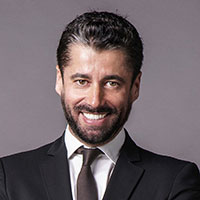
Having studied photography, neuroscience, medicine and architecture, Warren Neidich brings to any discussion platform a unique interdisciplinary position that he calls “trans-thinking.” He currently uses video and neon to create cross pollinating conceptual text-based works that reflect upon situations at the border zone of art, science and social justice. His performative and sculptural work “Pizzagate Neon” (2018), a large hanging neon sculpture recently on display at the 2019 Venice Biennial, analyzed the relations of Fake News, networked attention economy, evolving techno-cultural habitus, and the co-evolving architecture of the brain.
His recent conceptual project Drive-By-Art (Public Sculpture in This Moment of Social Distancing) just opened on the South Fork of Long Island and Los Angeles to acclaim including reviews in The New York Times, Hyperallergic, The Art Newspaper, Time Out and Los Angeles Magazine. He is founder and director of the SaasFee Summer Institute of Art (2015-), a theory intensive postgraduate course that attracts students worldwide operating in Los Angeles, New York City and Berlin.
He has been a visiting lecturer in art departments at Brown University, GSD Harvard University, Columbia University, Princeton University, Southern California Institute of Architecture, UCLA, La Sorbonne Paris, University of Oxford and Cambridge University.
There is always an experience of excitement when navigating an overwhelmingly interesting aggregate of information.
There are too many important threads to follow and too many possibilities to weave them.
Dots-lines-planes (plateaus) revolve fluently, dynamically intersecting in a heterogeneous complex.
Intertwining resonations at a sensitive, emotional and cognitive level.
Such was the nature of my encounter with Warren Neidich’s work.
When facing such an imminent incapacity for synthesis, I often return to the concept of interface as a complex of mediation. It helps me to navigate and allows me to observe everchanging connections, because my standing point is the in-between space. From there, I can follow the path of the activated interstices between different elements. This is how I hope to see Warren Neidich’s work at work, doing what it does: combining.
art, science and social justice
theory and practice
concepts and instances
and doing so by creating and curating artworks.
In an interdisciplinary position and exercising the possible “trans-thinking”, I feel confident to grasp the originality on these impure territories for creation.
Neidich works in the “border zone of art, social justice and science”. This means not only recognizing the tangencies of these fields but to move further, deeper, to the very fabric that dynamically links photography, neurosciences, medicine and architecture.
To work in between.
To work in the transposing place in which metaphors flourish,
not on one side, not on the other, on both, on none.
Hybrid.
This is a happy vibrating place, where intermittent liaisons change by the moment.
Not permanent.
Plastic.
And the artist lets this in-betweenness be patent in the artwork. I believe this is what Warren Neidich means by saying he is a wet artist. He reverses “the conceptualists’ movement that withdrew sensitivity from their artwork in the search for a pure cognitive experience”. An interdisciplinary practice cannot be dry, it’s nature it not one of restraining, or of sustaining cleavages, or even of withholding possibilities in the search for purity. On the contrary, it is inclusive, open, and embraces the crossbreed: the mutt, if I may say so.
The be open is to be changeable.
To be reconfigurable.
To leave all options available.
To be open is to be unlimited and to accept the stimulus that come from without (environment)
To recognize the influence of your milieu.
And to act upon it.
And to act is the possibility to change, perchance to attain truth and reestablish justice.
Wet, through moist media (in Ascott’s assertion).
In the firm believe that it is through the interface that media are experienced and therefore instantiated in space-time-matter, this reference to moist media leads me to question the materiality of Neidich’s work.
Artworks’ matter
It is absolutely necessary to consider matter in its trinity along with space and time, and to do that through light:
“Once astrophysicists stop talking exclusively about ‘space-time’ and start talking about ‘space-time-matter’ […] introducing a third kind of interval of the ‘light’ type alongside of those of ‘space’ and ‘time’, they engineer the emergence of a new conception of time, which is no longer exclusively the time of classic chronological succession, but now a time of (chronoscopic) exposure of the duration of events at the speed of light”
Paul Virilio, Open sky. (London: Verso 2003) Reprint. ed. p.3
From Einstein on, understanding space-time implies considering the masses, the particles and their behavior, namely through its relation with light: something very appropriate in this digital dematerialization era. Even more appropriate is to consider Light Art in this digital dematerialization era.
Immediately comes to mind the artists’ text-based neon sculptures. With their “light” material and in their networked textual arrangements, they open possibilities of interconnection.
the continuum
from past to present, of art
from material to immaterial, through light
from network-based model of the brain to networked digital experience.
And through this apparent continuity of space-time-matter (continuous only in our experience level, yet granular and dynamic on its fabric) these pieces mirror the subject of our time. A subject whose individuality and sociability are technically determined and equipped, not only in terms of sensitivity and sensibility, but also in terms of affections and emotions.








.jpg)
.jpg)
.png)